All Services

Virtual Screening

Find candidate molecules for your target before you go to the bench — by 2D similarity, chemical substructure, 3D pharmacophore and machine-learning QSAR — then shortlist them by drug-likeness and ADMET and pass them straight on to docking and molecular dynamics.

21compound databases
15.9 Mcompounds
1.1 M+molecules with 3D conformers
for pharmacophore screening
4screening methods

From a question to a shortlist

Each step is a module of the MolDock platform; results flow from one to the next.

Start
known actives (SMILES / SDF), a protein–ligand complex, or measured activities
Search
similarity, substructure or 3D pharmacophore over the databases
Predict
QSAR models estimate activity, with an applicability domain
Triage
drug-likeness rules, ADMET properties and structural alerts
Dock & simulate
hits handed to docking, MD and binding free energies

Screening methods

2D similarity & substructure

Fingerprint & Substructure Search

Rank every database molecule by its structural similarity to one or more known actives, or retrieve all molecules that contain a scaffold or functional group.

  • Morgan (ECFP4) fingerprints, 2,048 bits; Tanimoto similarity
  • Substructure queries as SMILES or SMARTS, optional tautomer enumeration
  • Hit counts at every Tanimoto cut-off; 3D SDF extraction with a drug-like filter
  • Excel hit lists, SDF files and PDF reports

Similarity search: a query and three database hits with their Tanimoto similarity
A cathepsin S inhibitor and DrugBank compounds found by similarity (Tanimoto 0.56–0.67).
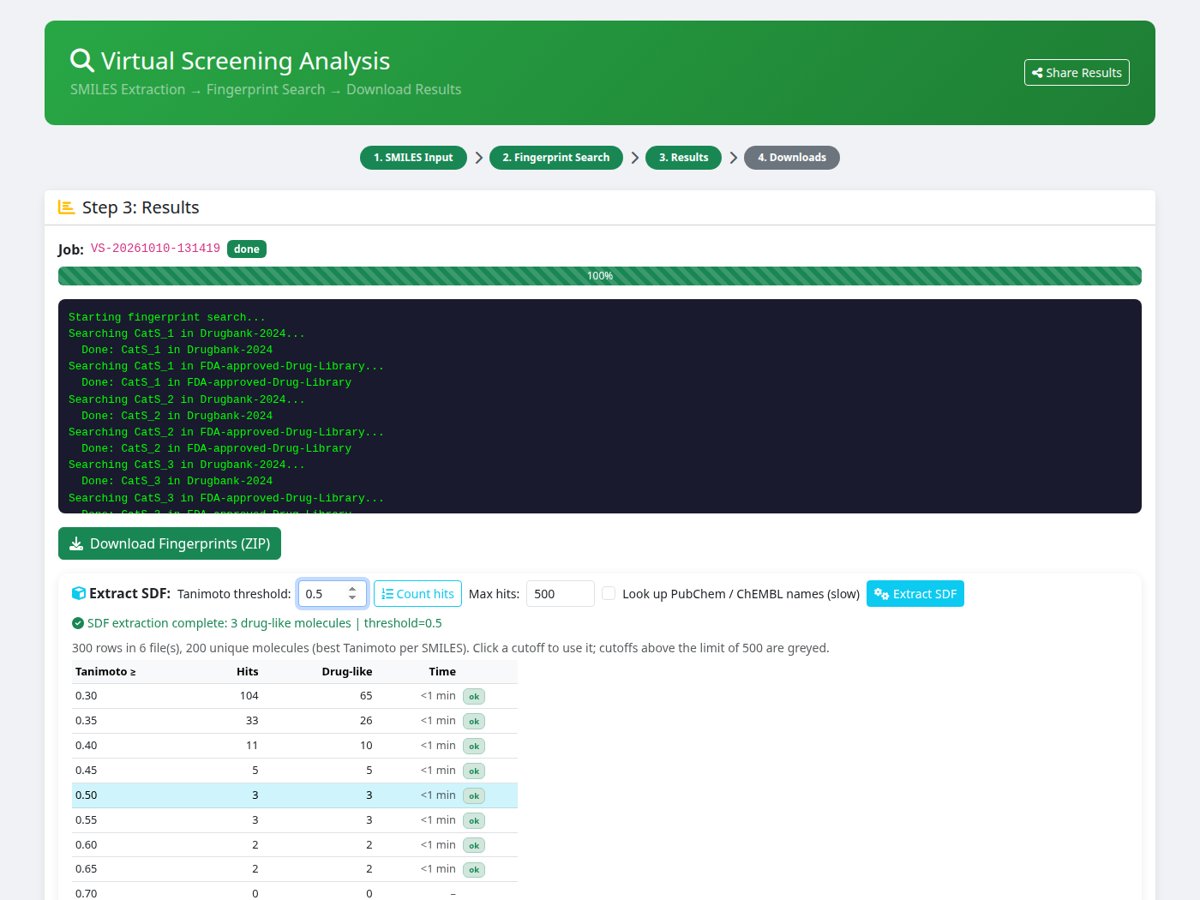
Fingerprint search results page
Search results: the hits per database and Tanimoto cut-off, ready for SDF extraction.
3D

Pharmacophore Screening

Describe what a ligand needs to bind — hydrogen-bond donors and acceptors, hydrophobic and aromatic groups, charges, in their 3D arrangement — and find molecules of any scaffold that can match it.

  • Models from a protein–ligand complex (e.g. a PDB entry), a docked pose or active ligands; editable feature by feature
  • 3D conformer ensembles (CONFORGE) for your libraries; pharmacophore-ready databases of natural products, drugs and metabolites
  • Model validation with actives and decoys: ROC, AUC, enrichment factors
  • Aligned hit poses, sent directly to docking or QSAR prediction

Built on CDPKit (University of Vienna).
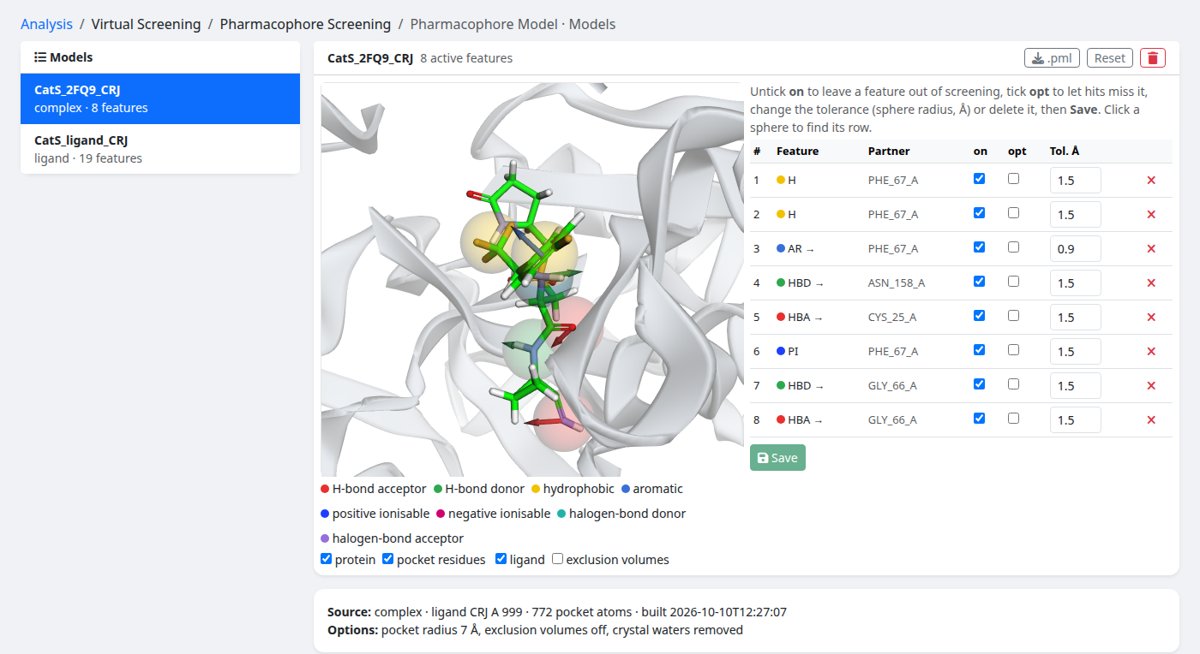
Pharmacophore model editor with 3D view
A pharmacophore from the cathepsin S crystal structure 2FQ9: eight features on the bound inhibitor, each editable.
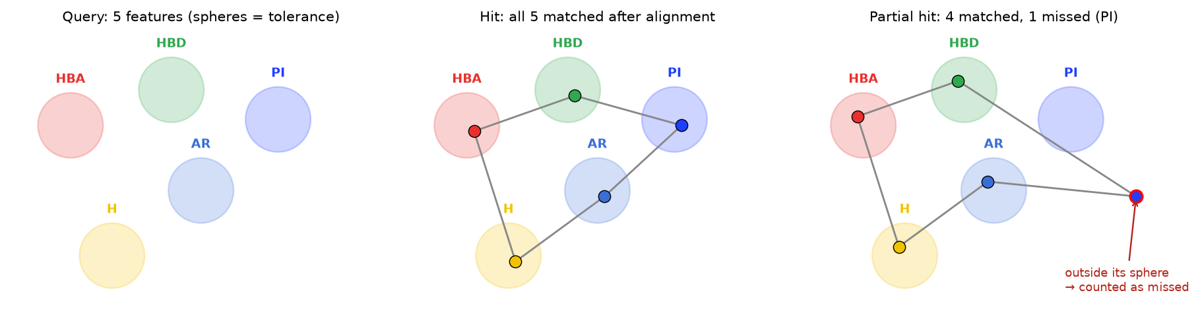
How pharmacophore matching works
Matching: a hit places its features inside the model's tolerance spheres.
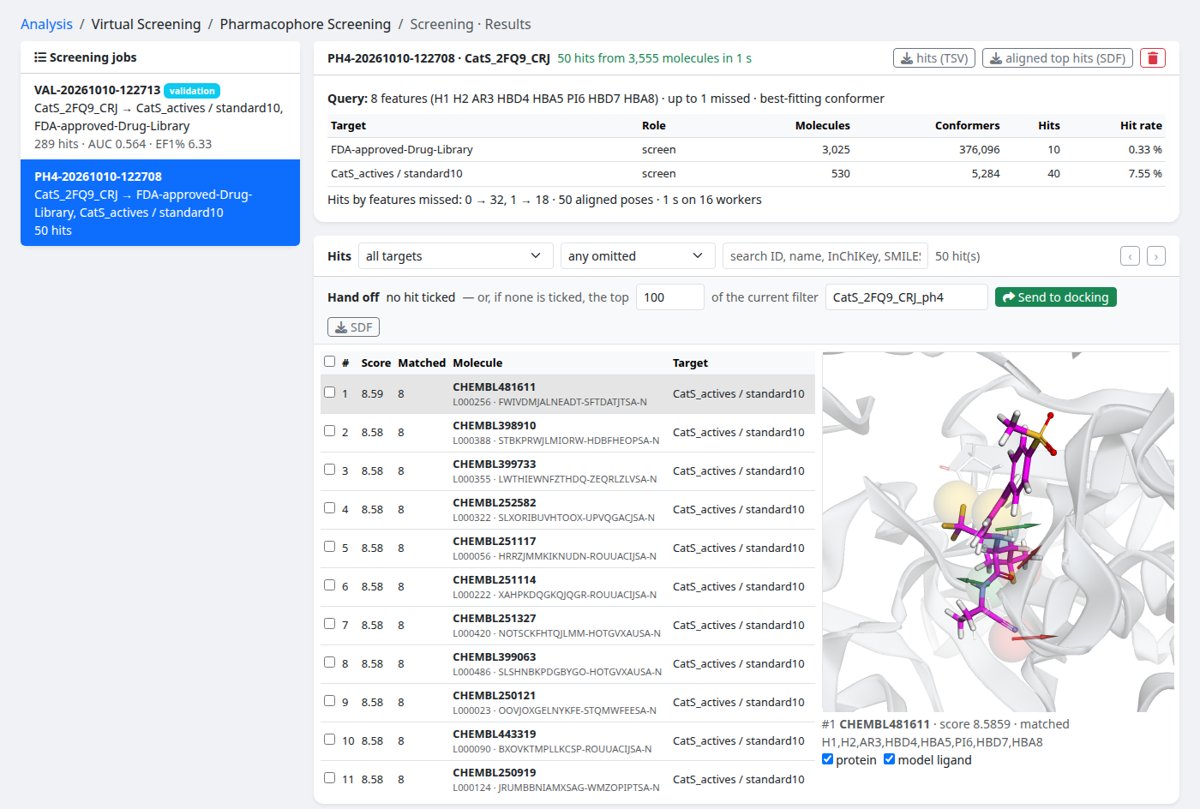
Pharmacophore screening results
Ranked hits with their aligned 3D poses.
Machine learning

QSAR Modelling & Prediction

Learn the relation between structure and measured activity for your target, and predict the activity of new molecules — with the validation reviewers expect.

  • Curated datasets from ChEMBL or your own data (standardisation, duplicates, units)
  • RDKit, Mordred and PaDEL descriptors, fingerprints
  • MLR, PLS, random forest, extra trees, gradient boosting, SVR, kNN; classification models
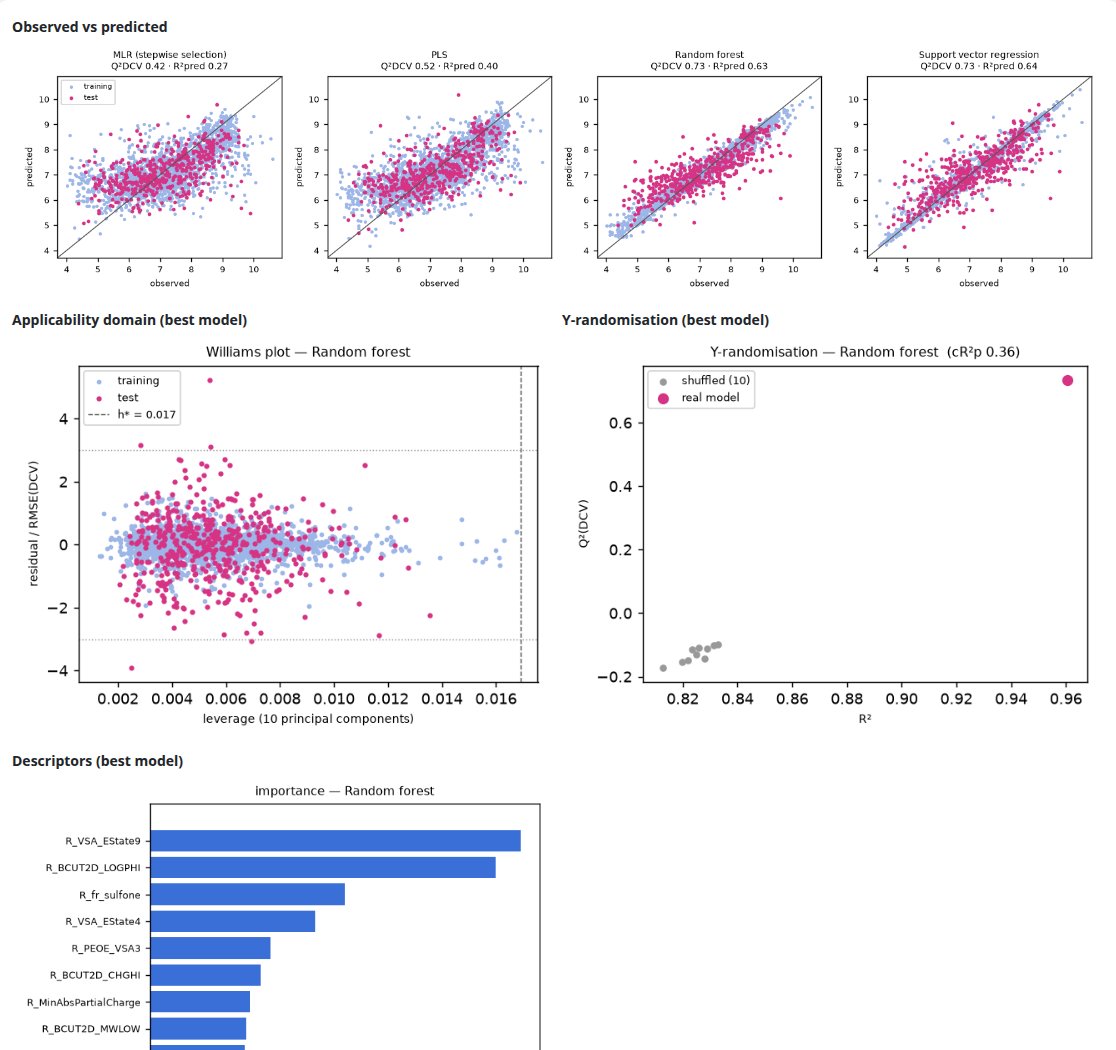
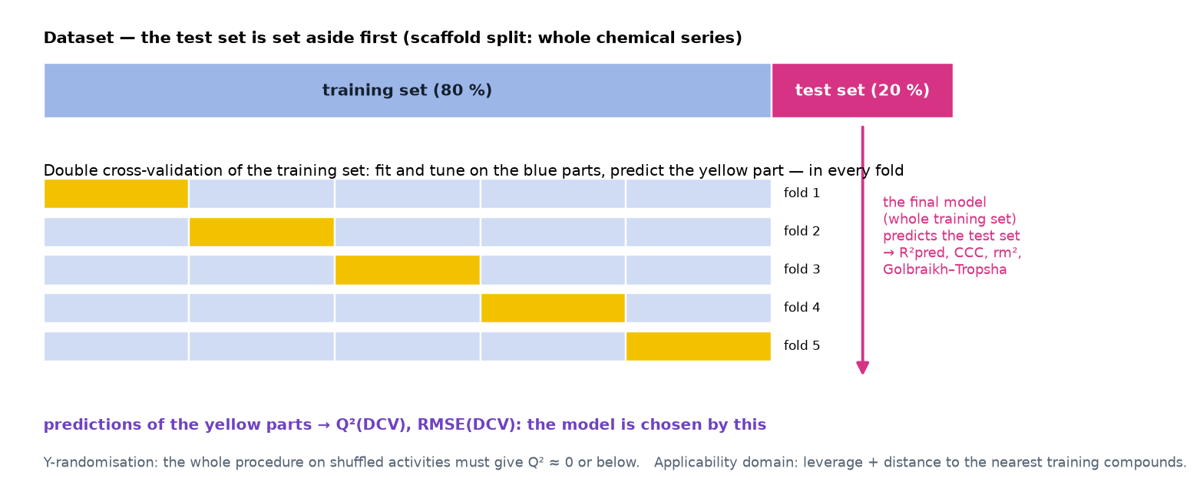
  • Scaffold / random splits, double cross-validation, Y-randomisation, Golbraikh–Tropsha criteria, applicability domain (Williams plot)
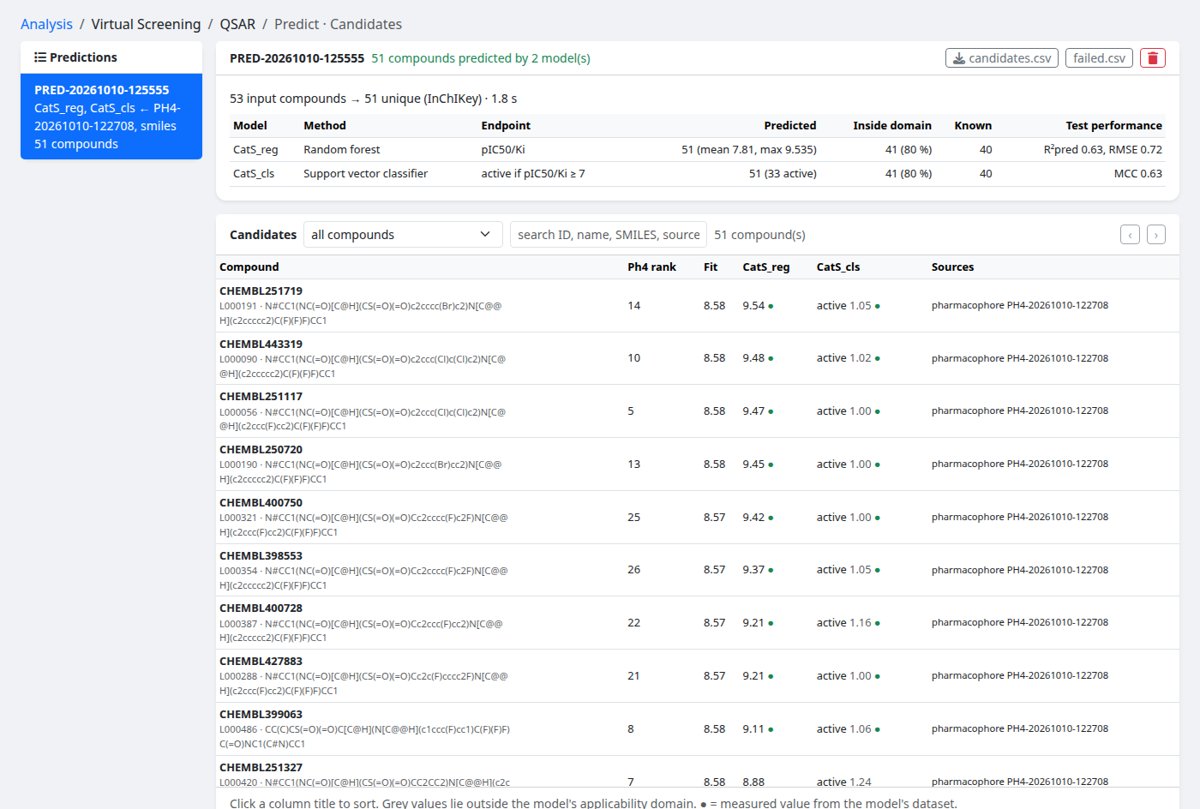
  • Predictions for SMILES, files, libraries and pharmacophore hits; OECD-style PDF report
QSAR model validation plots
Model comparison for 2,437 cathepsin S inhibitors: observed vs predicted, Williams plot, Y-randomisation, descriptor importance.
Double cross-validation scheme
Test set set aside first; double cross-validation on the rest.
QSAR candidate table
Candidates with predicted activity and domain flags.
Triage

Drug-likeness & ADMET Screening

Shortlist hits by the properties that decide whether a molecule can become a drug.

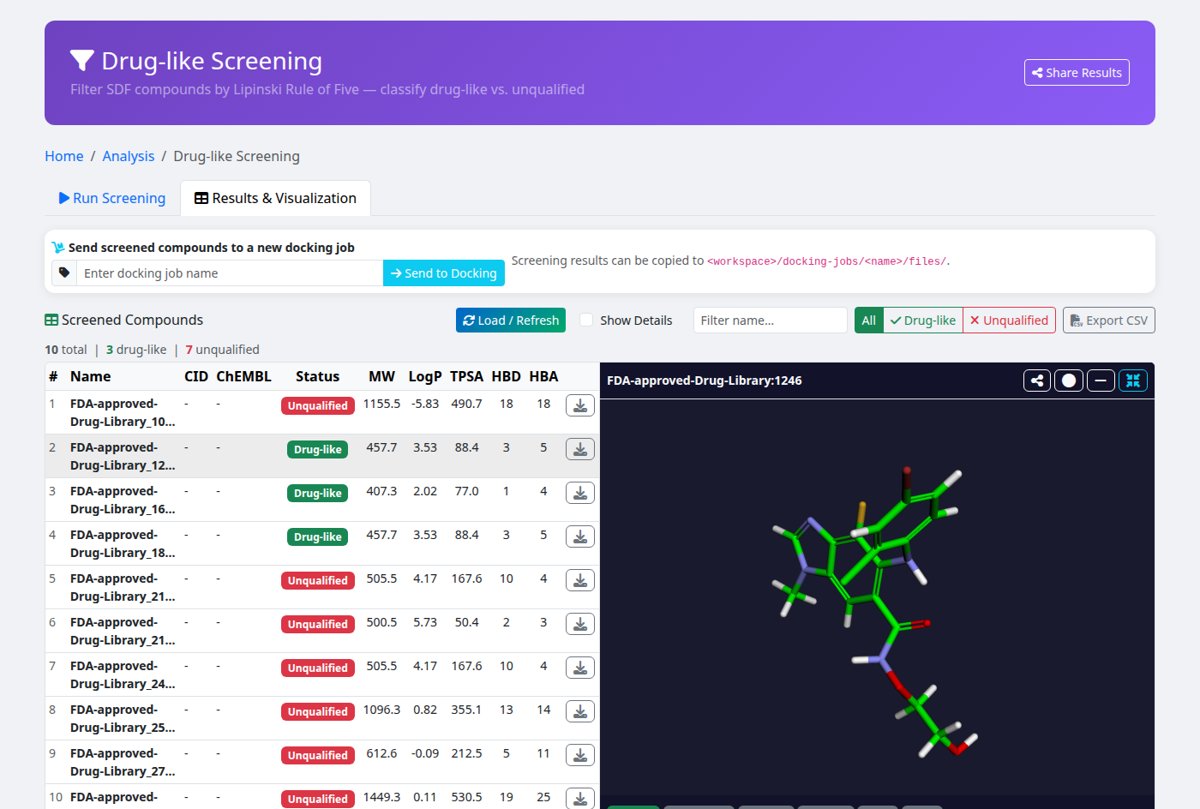
  • Lipinski, Veber, Ghose and QED drug-likeness
  • Physicochemical properties: MW, logP, TPSA, H-bond donors / acceptors, rotatable bonds
  • Structural alerts (PAINS, Brenk)
  • Interactive tables, 3D viewer, PDF reports; selected molecules sent to docking
Drug-like screening results
Drug-like screening of a hit set with pass / fail per rule.
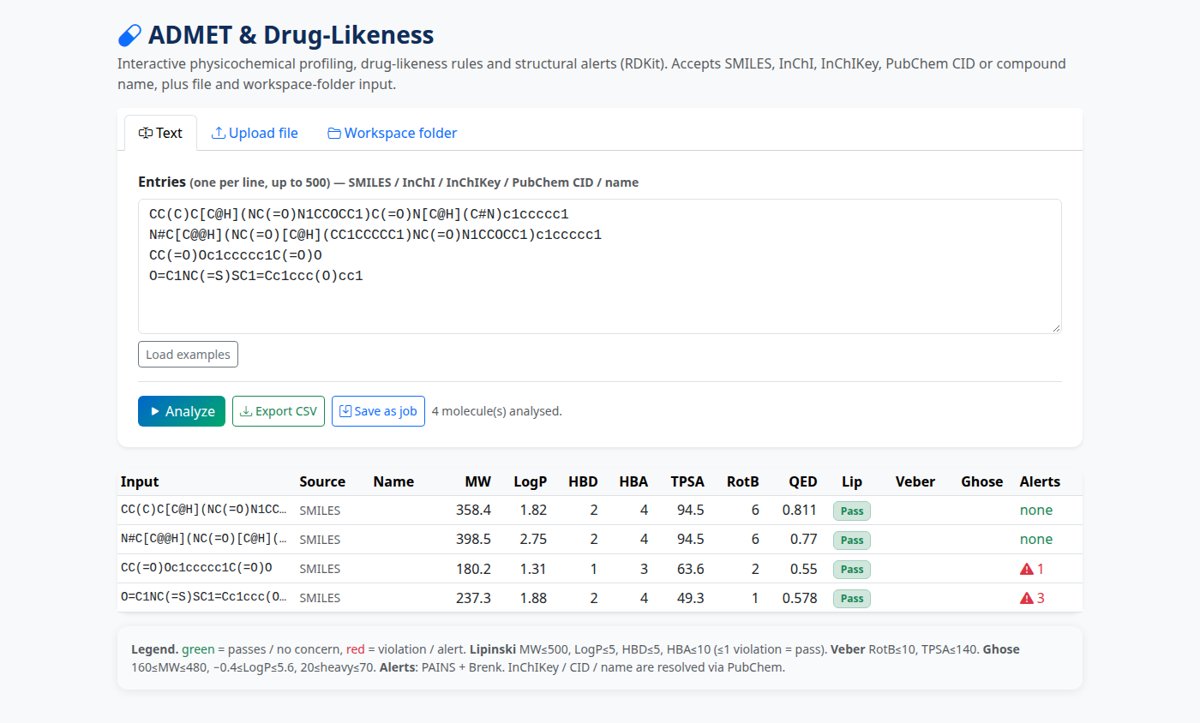
ADMET and drug-likeness analysis
ADMET & drug-likeness of individual molecules.

Example: cathepsin S

A worked example from our documentation, with public data — cathepsin S is a cysteine protease and a drug target in autoimmune disease and pain.

3 queries
known inhibitors searched by similarity and by their nitrile warhead in DrugBank and approved drugs
8 features
pharmacophore from the crystal structure 2FQ9, validated with 530 ChEMBL actives against 3,025 drugs
Q² 0.73
random-forest QSAR on 2,437 compounds (double cross-validation; R²pred 0.63 on an unseen scaffold-split test set)
→ docking
pharmacophore hits handed to docking with AutoDock-GPU, Vina and smina

Compound databases

21 databases, 15.9 million compounds, standardised and fingerprinted (VSFlow). 3D marks databases already prepared for pharmacophore screening; more are being added.

DatabaseContentCompounds
Purchasable & bioactive
ZINC drug-like, in stockpurchasable compounds9,535,778
ChEMBL 34bioactive molecules with measured activities2,409,139
Natural products
COCONUT 2026 3Dnatural products736,695
COCONUT 2022natural products (earlier release)406,897
LOTUS 2021 3Dnatural products with their organisms276,518
DRDS-PhytoDB 3Dphytochemicals (CCBB in-house)18,136
Plant secondary compoundsplant metabolites2,784
DatabaseContentCompounds
Drugs (repurposing)
DrugBank 2024 3Dapproved and investigational drugs9,716
e-Drug3D 3Dapproved drugs, curated 3D2,059
FDA-approved drug libraryapproved drugs3,043
PubChem drug & pharmacology sets 3Dmedications, pharmacologically active, KEGG drugs49,337
Metabolites & structural
HMDB 3Dhuman metabolites (incl. serum subset)217,759
PubChem metabolite & food setspathway metabolites, food additives18,483
PDB ligandsligands and chemical components of the PDB2,221,875

Your own compound collections can be screened as libraries (SDF), and new databases can be added on request.

What you receive

  • Ranked hit lists (Excel / CSV) with identifiers, properties and scores
  • 3D structures of the hits (SDF), aligned on the pharmacophore where applicable
  • PDF reports with figures — similarity, pharmacophore, QSAR (OECD checklist), drug-likeness
  • A Methods & parameters record of every step — software versions, settings and commands for your thesis or paper
  • Direct hand-off to docking, molecular dynamics and binding free energies on the same platform

Infrastructure

  • 2 × Intel Xeon Gold 6342 (96 threads)
  • 384 GB RAM
  • 3 × NVIDIA A30 GPUs
  • VSFlow · RDKit · CDPKit · scikit-learn · Mordred · PaDEL

Have a target in mind?

Register and request a screening — or contact us to discuss a research collaboration.

Get Started Contact Us